
Ligonier Valley Rail Road Newspaper Articles
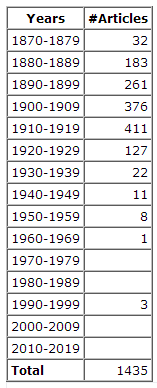 We have compiled over 1,400 newspaper articles that mention the Ligonier Valley Railroad, or related subjects. The articles were originally published starting in 1873 and our collection runs through 1995. Enjoy!
Pittsburgh Dispatch
Sunday, September 4, 1892
BLOCKS FOR PAVING
How 13,000,000 of Them Have Been Hammered Out for Pittsburg
BIG QUARRIES NEAR LIGONIER
The Softest of Iron Used in Sawing Up the Hardest of Stone
A NEW IDEA FOR COUNTRY ROADS
(CORRESPONDENCE OF THE DISPATCH)
Ligonier, Aug 27.
IX hundred men, for six years, with the interruptions only of the Sundays, have been hammering away at the Ligonier block stone quarries, three miles below this place, and the owners of this rich deposit say their great works are just now rightly opened. The Ligonier blocks are especially familiar in Pittsburg. Already about 45 miles of the streets of that city have been paved with the substantial blue stones, and if the favorite city contractors have their own way many more miles of Pittsburg streets will be paved in the same way within a few years.
The blue stone blocks used for paving in Pittsburg come from a deposit near the Packsaddle, an outcrop on one of the spurs of the Allegheny Mountains. Another deposit of the same quality of stone is found above Connellsville on the Baltimore and Ohio road, an outcrop from another spur of the same mountains, but the Ligonier blue stones, as all the deposits are called, seem to be native in the Ligonier Valley.
Seven Millions of the Blocks
Last year there were taken from the Ligonier quarries and transferred to the streets of Pittsburg just 7,000,000 of the blue stone blocks. Two years ago about 3,000,000 of the blocks were transferred in the same way, and this year it is estimated that 3,000,000 more of the blocks will be sent to Pittsburg for paving purposes. The blocks were first introduced in Pittsburg five years ago. They are almost imperishable, and are said to be almost as hard as adamant.
The great quarry was originally opened for street paving stone, but within two years it has been supplying a little of everything that is made from stone. Plans for stone houses are now sent to the quarry here, and the structure in sections is shipped away, every piece numbered and ready to be put together, thus recalling the building of Solomon’s Temple of old.
The building stones as well as the paving blocks are chopped out of a mammoth rock, the face of which is now exposed to a depth of 65 feet and extending along the ridge for nearly a mile. The rock is first blasted by drilling with compressed air. Glycerine (sic) is poured into the holes and exploded as an oil well is shot. One blast as a rule tears out enough stone to build a house or two, and exhausts an ordinary appropriation for street paving block.
Sawed With the Softest Iron
The building stones are carried down on an incline from the quarry to the sawmill, where they are sawed out according to plans and specifications. Sawing stone is not much of a novelty. Many quarries saw out building stones, and some of them use diamond pointed saws of rare value and great cost. But sawing Ligonier block stone, the hardest in the market, with the softest iron made, is an innovation and can be seen at no other quarry in this country. The saws are made especially for the purpose and are made especially soft. They are ordinary iron bars about 10 feet long, 3 inches wide and 3-16 of an inch thick. The rough stones are placed on trucks and rolled in under the saws that are set in substantial frames. The saws are operated just as the saws in any mill are operated. Under the saw is a pool of water into which a certain amount of crushed steel is thrown. The steam power operating the saws pumps the water and crushed steel into the saw’s track and the soft iron blades with the assistance of the water and steel, carves through the rough stone like a cheese knife would wade through a roll of fresh butter.
There are three saws in the mill here, and two men are required to operate each of them. A branch of the Ligonier Valley Railroad extends up to the door of the mill and the stones as sawed are shifted from the trucks to the cars. Besides building stone, flags for street crossings are sawed out, and just near the saws is a huge polishing machine, where a patent-leather shine is put on any of the stones desired.
None of the Stone Gets Away
Alex McCance, superintendent of the quarries here told me yesterday that for the past five years an average of 20 cars a day of the various kinds of stone turned out have been shipped from here, and he also said that not an ounce of the great rock from which the stone is taken has been wasted in that time. The paving blocks are supposed to be the finest quality of the material. The building stones, fence posts and curbstones are next the pieces broken off in the various operations are gathered up by a steam shovel and thrown into the yawning mouth of a hungry steam crusher. From the crusher the pieces pass into a huge revolving screen by which the different sizes are separated and are carried by a chute down to the railroad probably 600 yards below. The first quality of the crushed stone is used for railroad ballast. The second grade, just a size smaller, is used in making beds for asphaltum pavements, and the quality which is fine almost as dust is used in the manufacture of asphaltum and can be seen in its raw state at nearly every station along the Pennsylvania Railroad, where it is used as a pavement instead of the wooden platform formerly used. In fact, the only material from the quarries that escapes is the dust that rises like a fog from the revolving screen, and even it serves a purpose, as it settles over the quarry buildings and practically paints them white and preserves them just as paint would.
Hammering Out a Paving Block
A paving block is hammered out by hand. But little skill is required. A blast hammer is used, and the quarryman guesses at the size. He first draws his dull hammer over the face of the stone marking out the size of the block, and he then hammers away and the block really seems to form itself. The quarrymen are paid $20 per thousand for the blocks, and it requires about four days for an industrious workman to chop out a thousand blocks.
Superintendent McCance says there is enough stone in his quarry to pave the streets of every city and town in the United States. He has recently been experimenting in country road making with the stone dust turned out, and he claims the country roads of the State could be improved and made smooth and durable with the dust cheaper than with any other material. The roads he has himself improved with the dust are as smooth as a carpet and they appear everlasting. It is not likely, however, that the Ligonier quarry owners will devote much attention to country roads until they have exhausted their contracts in Pittsburg streets.
It is just a trifle difficult to conceive the amount of stone that has been taken out of this quarry since it was first opened. Its discovery was an accident, but its operation has been a golden harvest.
Within three years 13,000,000 paving blocks alone have been taken out. Counting their length, between nine and ten inches, they would, if placed end to end, make a column 2,000 miles long.
HERBERT