

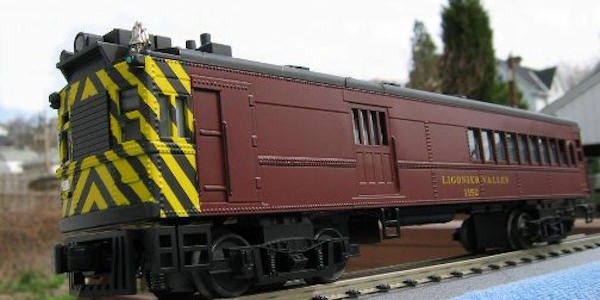
Ligonier Valley Rail Road Newspaper Articles
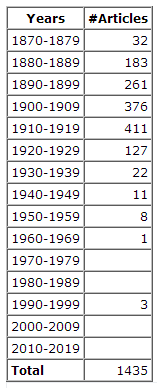 We have compiled over 1,400 newspaper articles that mention the Ligonier Valley Railroad, or related subjects. The articles were originally published starting in 1873 and our collection runs through 1995. Enjoy!
Pittsburgh Press
Sunday, October 12, 1890
The Ligonier Quarries
How They Came To Be Discovered By James Booth
Interesting Details of the Mining of Pittsburg's Favorite Paving Stones
Probably few people who regard the now celebrated Ligonier paving stone as indispensable to the streets of any well regulated municipality have the most remote conception of the wonderful growth of the peculiar industry involved in getting this stone ready for use on the streets as a roadbed. Away back in the early '70s the value of the Ligonier stone became apparent to a few men who were familiar with the needs and requirements of street paving, and who realized that the cobble stone must go. Among the number was Mr. Hatch, then agent in this vicinity for the Schenley estate. As the now well-known quarries of Booth & Flinn are situated on the property of Mrs. Schenley, in the Ligonier valley, it was quite natural that Agent Hatch should have endeavored to interest capital in opening and operating quarries upon the estate.
James Booth, of the well-known firm of Booth & Flinn, who is the acknowledged pioneer in this branch of the firm's business, visited the property in question and was favorably impressed with its value as a location for quarries. This was shortly before the memorable panic of 1873, and the railroad projected as a branch from the Pennsylvania Railroad to Ligonier was not then completed. The grading had been finished ready for the ties and rails. The panic ensued and the uncomplete road was sold at sheriff's sale to satisfy claims for labor and materials. The stone was there in great abundance, but until the railroad could be completed the opening of quarries was impracticable.
Mr. Booth became convinced that the ledge of this peculiar stone might be found cropping out along the headwaters of the Monongahela river, and if he could find it near the line of the Baltimore & Ohio railroad he could secure all necessary facilities for transporting the stone to Pittsburg. After a long and tedious search Mr. Booth was successful in finding a plentiful supply of the stone directly on the line of the Baltimore & Ohio railroad some distance above McKeesport.
A short time after this the firm of Booth & Flinn was organized, and the extensive quarries on the Baltimore & Oho railroad were opened and operated on a large scale. It remained, however, for the completion of the Ligonier branch road to develop the quarries now operated by the firm in the Ligonier valley, although they also opened a quarry at the Packsaddle on the main line of the Pennsylvania railroad. The quarries at the point last named are located upon a tract of land comprising several hundred acres, the grater portion of which is said to be underlaid with stone of the Ligonier kind. This property the firm purchased several years ago.
The quarries of the firm in the Ligonier valley are located about four miles from the town of Ligonier. The firm has leased quite a tract of land at this point from the Schenleys, and the quarries are now being operated most extensively. As the output runs up to hundreds of tons daily the pay roll at one of the quarries amounts to nearly $20,000 per month.
The face of the steep hill has been cut down over an area of fully 1,000 feet, the drilling preparatory to blasting being done with pneumatic drills. At each blast hundreds of tons of rock are dislodged. The stone thus detached is again split up by what is known as "light blasting." This breaks them up in strips or irregular blocks. Then comes the most interesting part of the work. A large number of expert workmen next attack the large sections of stone with sledges and stone picks of various sized, and the work of fashioning the brick-shaped blocks is soon accomplished. A blow with the large sledge breaks the irregular stones into cubes as nearly as may be. Then the smaller stone picks, or hammers, come into play. The men become so expert by long practice that it require but one or two blows of these hammers to reduce the rough stone into blocks of the regulation size, almost as perfect as if fresh from a mold. The men make large wages on piece work, frequently turning out 150 perfect blocks each for an average day's work. They are paid 2 cents a block.
These blocks in every case must conform to the regulation gauge of the inspector, whose duties in examining the blocks fully occupies his time. A remarkable feature to be observed in an inspection of the work at these quarries is the fact that every scrap or fragment of rock is utilized, either as ballast or in the form of concrete. At the scene of operations is a monster crusher, with a capacity of turning out 18 carloads of ballast a day. This ballast is all purchased by the Pennsylvania Railroad as fast as it is turned out. When the blocks of stone used in paving the streets in this city are placed in position, each represents a cost to the city of about 5 cents.
Time and experience have demonstrated the Ligonier block, while comparatively expensive as a paving material, yet it is not excelled in point of durability. It possesses other advantages, such as presenting an even surface, etc., but this features which have recommended it to t public favor and already too well known to require more than a passing notice. There are other firms in the city that have quarries in the Ligonier region, but none of them are operated son extensively as that of Booth & Flinn.